
Adorazione dei Magi
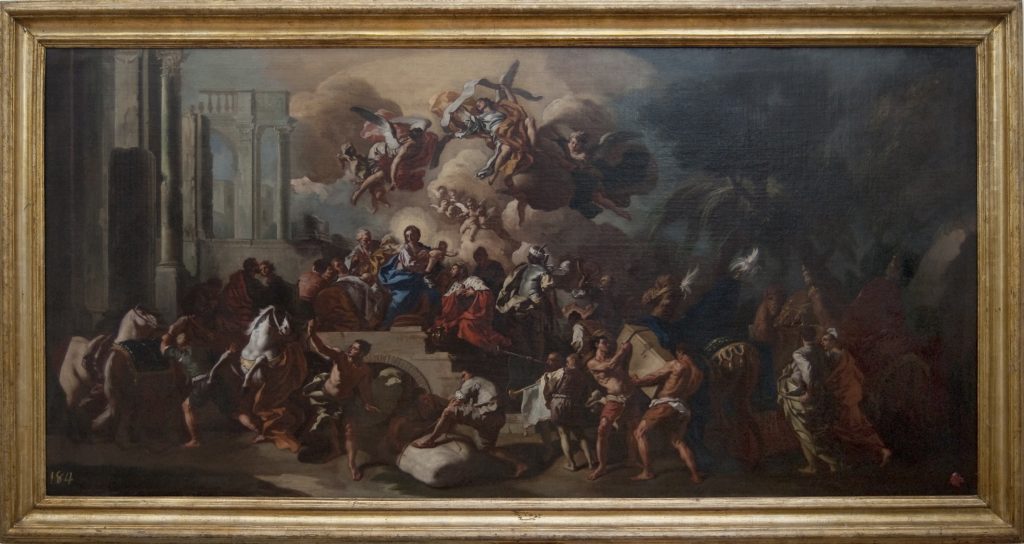
Adoration of the Magi
1731-1732
Oil on canvas, 100 x 208 cm
Provenance: Naples, inheritance of Francesco De Mura (1782) inv. Spadetta 1782: s.n.; inv. Palumbo 1782: s.n.; inv. [Venuto 1783?]: s.n.; inv. Fischetti, Bardellino I 1783: 92; inv. Fischetti, Bardellino II 1783: 92; inv. Diana 1802: 184; inv. La Volpe, Guerra 1845: 184; inv. Simonetti 1851: s.n.; inv. 2009-2010: 59; record OA: 15/00409981
This notable sketch is related to the fresco, signed and dated (“Fran[ces]co de Mura F[ecit] A[nno] D[omini] 1732”), in the apse conch of the Santissima Annunziata, always known to all as the Nunziatella, the new church of the then Jesuit Novitiate at Pizzofalcone (today the Military School; fig. 1). The foundation stone was laid on 25 March 1713, and the church was inaugurated on 13 November 1732, on the occasion of the feast of Saint Stanislaus Kostka, a Polish novice and champion of youth and the Jesuit school, canonised by Benedict XIII in 1726 (Iappelli 1987). The tribune, splendidly inlaid with polychrome marbles, also features a contemporary cycle of canvases by Ludovico Mazzanti, with the Annunciation at the centre.
After the insights and investigations by Richard Bösel (1985) on the architecture of the Society of Jesus, the design, construction, and decorative history of the Nunziatella, one of the most organic and precious sacred interiors of the 18th century, not only locally, has recently been the subject of a monographic revision (Bisogno 2018, with previous bibliography). One of the most problematic issues concerns the involvement of the architect Ferdinando Sanfelice. Be that as it may, in this church built ex novo, and thus without compromises of pre-existences and stratifications, nor significant subsequent alterations, the idea of integrated decoration, from the plan to the volumes, between the paintings and the marbles, is realised to a high degree: it is, par excellence, the space-colour of the late Neapolitan Baroque. De Mura worked there in two distinct moments, spaced out in time.
The painting under examination relates to the first intervention (regarding the second, which took place in the mid-18th century, and for the related sketches, already at the Pio Monte, cf. here cat. III.1.114; on the entire cycle: Enggass 1964; Di Maggio 1987; Rizzo 1989; Di Maggio 1999; Roettgen 2007). For the apse decoration in question, one of the acclaimed masterpieces of the artist’s early maturity, by then independent from Solimena for about five years, at least one payment slip is known: De Mura had received an advance in September 1731 from Father Domenico Ludovici, then rector of the Novitiate and a famous poet and epigraphist (Giambattista Vico called him the “Christian Tibullus”: Errichetti 1979), receiving the final payment, for a total of 470 ducats, exactly one year later, from Father Francesco Scacchi; and the sum included the compensation for the altarpiece destined for the Chapel of Saint Francis Xavier (Rizzo 1989). This phase of work also includes the other altarpiece by De Mura depicting the Madonna and Child with Saint Ignatius of Loyola for the adjacent chapel, dedicated precisely to Saint Ignatius, on the left side of the single nave. For this painting, documented by another payment slip at the end of 1732 (Rizzo 1989), the sketch is also known, once believed to be by Solimena, and now belonging to the Capodimonte collections (N. Spinosa in Museo e Gallerie Nazionali di Capodimonte. Dipinti del XVIII secolo 2010). This is not, of course, the place to summarise and comment on the iter of the consultations of the fathers in the Neapolitan Novitiate regarding the problem of pictorial decoration, which led to the outcomes we know (for which see Iappelli 1987; Iappelli 1993; Bisogno 2015; Russo 2017; Bisogno 2018). It was discussed in a timely manner, already from 1726, when the main candidate, before De Mura’s affirmation, was Paolo de Matteis. Moreover, in the consultations there are no specific references to the painting of the apse, it being taken as implicit in the more general discussions concerning the ornamentation of the vault. And let it suffice here to recall that among the firmest and most founded intentions – as emerges from the session of 20 October 1726 – was that the ceiling should necessarily be painted, and not just gilded (as had also been proposed as an alternative): “the work of the marbles having begun throughout the church, it did not seem that gold was suitable in the vault, because the marbles required painting.” From other documentation, moreover, it would seem that initially the patrons wanted to use, in the apse conch, Gerolamo Cenatiempo, paid between 1729 and 1730 for “the sketch of the painting of the vault of the tribune” (cf. Bisogno 2018, who however cautions that “the payments made to him in this period pertain to a settlement of the painter for the work carried out”). The news perhaps awaits further verification, but, if that was the case, we naturally cannot but rejoice that De Mura took over the work from Cenatiempo, who was in any case engaged in other spaces of the church, and a much more modest painter.
The stylistic point highlighted by our painting is close to that of the two sketches, conserved in the Molinari Pradelli collection in Marano di Castenaso (Bologna), for the paintings of the Chapel of Saint Bertarius formerly in the abbey church of Montecassino, for which De Mura was commissioned in 1731 (cf. A. Brogi in Barocco italiano 1995): one notes, for example, besides the recurrence of types, the same somewhat broken and chipped handling of the draperies, which mostly tends to smooth out in the final painted execution. De Mura had experimented with the theme of the Adoration of the Magi on a large scale for the canvas in the church of Santa Maria Donnaromita in Naples (1727-1728: Rizzo 1978), whose sketch, formerly at the Pio Monte, and donated in 1882 to the conservatory of the notaries’ daughters in Naples, has recently been traced (Russo 2019): the example of Solimena is still strongly registered there. From here De Mura develops the invention in the sketch under examination and adapts it to the concavity of the conch, with some modifications, for example suppressing the architectures studied precisely in the canvas, not at all indispensable for the fresco version, and replacing them with leafy trees, more suited to arch over the curved and gathered surface of the semi-dome. Nonetheless, those painted architectures betray, albeit in less solemn forms, the heritage – moreover very current – of the background in the mural of the counter-façade at the Gesù Nuovo, published by Solimena in 1725 (on the probable presence of the young De Mura in this enterprise of his master, cf. most recently Causa 2014). The other reference – it has been rightly said – was Solimena’s precedent in the sacristy of San Domenico Maggiore; a reference venerated and at the same time eluded by the greatest of his pupils. At the Nunziatella, “moreover, by slightly enlarging the proportion of the foreground figures, in the fresco De Mura brings the entire scene forward and increases the sense of contact with the spectator” (Enggass 1964). This seems in line, moreover, with that sentiment of sacred theatre, involving for the faithful, at which the rhetorical strategies of persuasion of the Jesuits aimed (Rizzo 1989). But above all, the painter, moving from the study to the fresco, opens up to the air and places everything in an unprecedented clarity, which unites the chromatic score: “colour that becomes, therefore, glittering, very lively, all imbued with light, liquescent” (Rizzo 1978, with the reference to the “milky beauty of atmosphere” evoked for the best De Mura by Bologna 1962a); colour, however, no less effective in a structural and compositional sense (for technical and restoration issues cf. Di Maggio 1991; a fine passage on the Adoration of the Magi at the Nunziatella, in the history of 18th-century fresco painting in the South, is by Causa 1998). Especially of Vincenzo Rizzo (1989), then, the no small merit of having valorised with documents the munificent role of ‘external’ patronage, and in particular that of the regent Duke Andrea Giovine di Girasole, in the erection and embellishment of the Nunziatella, to which his brother Giovan Michele Giovine also contributed. But Andrea alone, who died in 1734 and was buried there, is celebrated in the epigraph placed that year in the pavement of the tribune as the patron who “ornavit aram aream apsidem auro pictura marmore basilice”. Both the Giovine brothers received as a reward the privilege of being portrayed there (as half-figures in marble, works of the sculptor Francesco Pagano in 1734): an exceptional thing in that period in the churches of the Company in Naples (Nardi 1736). [Augusto Russo]
Bibliography*
Nardi 1736, p. 119; Ceci 1933c, pp. 11, 15; La mostra della pittura napoletana 1938, p. 331, n. 24; Lorenzetti 1938, p. 192; R. Causa in Mostra di bozzetti napoletani 1947, pp. 54-55, n. 51; Bologna 1962a, p. 76; Enggass 1964, pp. 134-135, fig. 3, passim; Causa 1970, p. 110, n. 101, pl. XXXI; Leonetti Rodinò 1975, p. 22, n. 73; Rizzo 1978, pp. 102-104; Errichetti 1979, p. 38; Bösel 1985, pp. 461-468; Spinosa 1986, pp. 156-157, n. 245; Di Maggio 1987, pp. 48-49; Iappelli 1987, passim, and p. 25; Rizzo 1989, passim, and pp. 19, 33 doc. 33, pp. 36-37 doc. 44; Di Maggio 1991, p. 130, and fig. 16; Il Pio Monte della Misericordia 1991, p. n.n. (but 18); Iappelli 1993; N. Spinosa in Settecento napoletano 1994, pp. 166-167, n. 17; A. Brogi in Barocco italiano 1995, pp. 210-211, nn. 107-108; Capobianco 1997, p. 67, fig. 57; Causa 1998, p. 225; Di Maggio 1999, p. 41; Guida rapida 2003, p. 18; Spinosa 2003b, p. 200 (and ill. on pp. 194-195); Roettgen 2007, pp. 364-377; Gazzara 2008a, p. 174; Gazzara 2008b, p. 227; Spinosa 2009, p. 32; N. Spinosa in Museo e Gallerie Nazionali di Capodimonte. Dipinti del XVIII secolo 2010, pp. 52-53, n. 48; Leonetti Rodinò 2012, pp. 52, 90; Causa 2014b, pp. 31-32; Bisogno 2015, pp. 53-54; Gazzara 2016, p. 58; In the Light of Naples 2016, pp. 109-113, n. 12; Leonetti Rodinò 2016, p. 70; Russo 2017, pp. 207-232; Bisogno 2018, passim, and p. 66; Lofano 2019, p. 195; Russo 2019, p. 160 note 30.
Acts and Documents*
inv. Spadetta 1782, c. 6v (Appendice II, 303, s.n.); inv. Palumbo 1782, c. 8v (Appendice II, 304, s.n.); inv. [Venuto 1783?], c. 5v (Appendice II, 305, s.n.); inv. Fischetti, Bardellino I 1783, c. 6r (Appendice II, 307, n. 92); inv. Fischetti, Bardellino II 1783, c. 4r (Appendice II, 308, n. 92); inv. Diana 1802, c. 15r (Appendice II, 309, n. 184); inv. La Volpe, Guerra 1845, c. 25v (Appendice II, 311, n. 184); inv. Simonetti 1851, c. 11v (Appendice II, 314, s.n.); Quadri rimasti invenduti 1884, c. 3r (Appendice II, 315, n. 184); Elenco de’ quadri 1905, n. 91, p. n.n. (but 5); catalogazione 1925, n. 9; catalogazione post 1933, n. 43.
Exhibitions*
La mostra della pittura napoletana 1938; Mostra di bozzetti napoletani 1947; Settecento napoletano 1994; In the Light of Naples 2016.
Restorations*
Tatafiore 2006.
Entry taken from: P. D’Alconzo, L.P. Rocco di Torrepadula (eds.), Pio Monte della Misericordia. Il patrimonio storico e artistico, Napoli, Arte’m, 2020, vol. II, cat. n. III.1.93, pp. 446-448 (available online at the page https://www.francescodemura.unina.it/en/painting-information-sheets/adorazione-dei-magi/).
All publication rights reserved: © copyright 2020 prismi editrice politecnica napoli srl; © copyright 2021 artem srl (for the entire catalogue); © copyright of the authors (for the texts and apparatus).
*References to bibliography, documents and restorations can be found by consulting the relevant sections in P. D’Alconzo, L.P. Rocco di Torrepadula (eds.), Pio Monte della Misericordia. Il patrimonio storico e artistico, Naples, Arte’m, 2020.